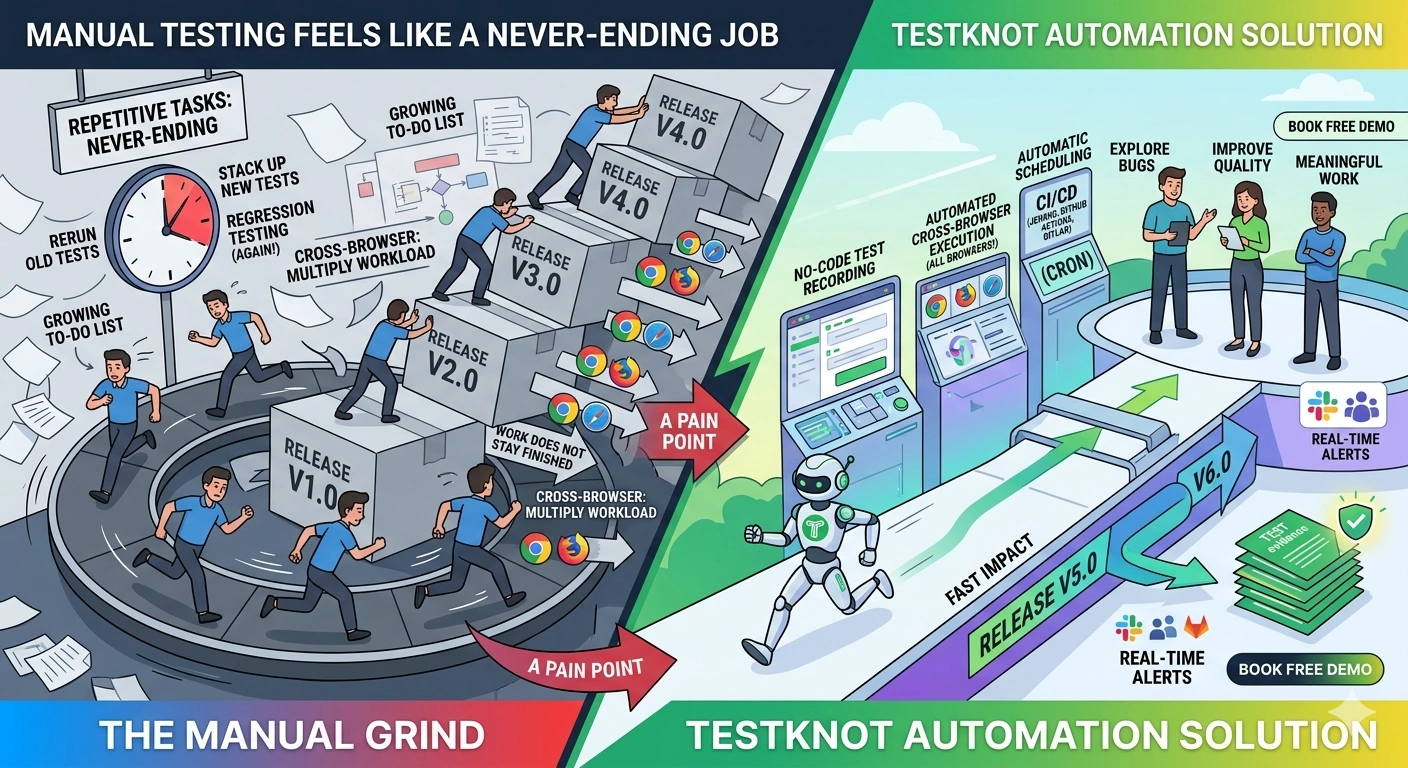
If you have done manual testing for a while, you know it never really feels done. Every release stacks up new tests, every change means you have to rerun old ones, and the list of stuff to check just keeps growing. It does not matter how hard the team works. The to do list keeps getting longer, not shorter. That is the built in reality of manual testing. It is set up to expand without a finish line.
So why does manual testing feel like it never ends?
There is a simple reason, and nobody talks about it enough. In manual testing, “done” is never permanent. A test case you ran last week? You will run it again this week, because something in the code shifted, even if it was not in the area you are testing. Regression testing means covering the same ground over and over, every single release. Instead of replacing old tests, new ones just add to the pile.
Most jobs are not like that. If someone builds a feature once, it stays built. Write a document, and unless things change, you do not need to edit it again. But with testing, everything resets every release. The baseline keeps expanding. That is why manual testing feels like a marathon with no finish line, and it is a real pain point.
What keeps adding to the workload?
New features add test cases. But there is more. Every new feature increases the regression load for everything that already exists. Change the checkout flow, and suddenly you have to check the whole purchase process again, not just the new part. Tweak the login system? Now every downstream flow that depends on authentication needs checking.
It gets worse with cross browser requirements. You have to run the same test on Chrome, Firefox, Edge, and Safari. Same steps, same expected result, just a different browser, but that multiplies your workload. And if you need to test across QA, staging, UAT, and production, that one test turns into many.
None of this is unreasonable from a quality perspective. It is all needed. The real problem is that doing it all by hand does not scale. Most teams hit their limit long before the product stops growing.
How does the pressure of release timelines make things tougher?
Deadlines do not care if your testing checklist got bigger. Product teams add features, engineers build them, and QA is told to check it all on a fixed timeline, even as the work grows.
The World Quality Report keeps highlighting this. Not enough time to finish testing is a common issue for QA teams, and it is not random. It is built into how software is developed and tested.
So QA teams end up making hard choices. Test everything and miss the deadline, or test what you can and risk missing issues. Neither option feels good. Both are common in teams stuck with manual work.
How does this affect the people doing the work?
This is the part most discussions ignore. It is always about speed and coverage, not about the people doing the work.
Manual testing is draining because it resets each cycle and never gives you a sense of completion. It is not that the work is hard. It is high volume, repetitive, and no matter how well you do it, the next cycle brings the same workload again.
QA engineers often want to explore bugs, test edge cases, and improve product quality. But most of their time goes into repeat work that does not need their skill. Over time, that gap between what the job could be and what it is leads to burnout.
Where does automation help, and where does it fall short?
Automation helps with repetitive work that does not need human judgement. Regression tests that run every release are a good example. Cross browser checks with the same steps are another. In these cases, manual effort adds little value but takes a lot of time.
The problem is setup. Traditional automation needs coding skills or developer support. If teams do not have that, automation feels out of reach, and the manual workload keeps growing.
How does Testknot help with manual testing overload?
That gap, wanting automation but lacking coding skills, is what Testknot solves. The browser extension captures test steps in real time, including selectors and actions, with no scripting needed. Instead of writing code, QA engineers can record test cases quickly.
Testing across browsers and environments happens from one place. Reusable test cases mean less repeated setup. CI and CD integrations with Jenkins, GitHub Actions, and GitLab allow tests to run automatically with every build, so there is no need to trigger them manually.
Test schedules can also run automatically with cron jobs. There is no need to remember when to run tests.
The result is simple. The most repetitive part of the job, rerunning the same tests across browsers and environments every release, is handled by the system. QA engineers can focus on work that needs real thinking.
Conclusion
Manual testing feels endless because it is designed to keep growing. Each release adds more work, nothing gets removed, and timelines do not expand.
The solution is not to work faster or accept incomplete testing. It is to identify repetitive work, automate it with tools that do not need heavy coding, and let QA engineers focus on tasks that need their skills.
Manual testing does not go away, but it becomes manageable. The job feels different when repetition is handled and effort goes into meaningful work.
Want to see how Testknot makes this shift possible for your team? Book a free demo and explore low code test automation built for QA engineers.
Frequently asked questions
Because the work never stays finished. Every release requires rerunning the same tests, and new features keep adding more. The workload keeps growing with no clear end.
New features add tests and expand regression coverage. Cross browser and multi environment needs multiply effort, since the same tests run in multiple places. Together, this grows faster than teams can handle manually.
Deadlines stay fixed even as the workload grows. Teams must choose between full testing and delays, or partial testing with risk. This is common in manual setups.
Start with regression tests and cross browser checks. Both are repetitive, do not need human judgement, and take a lot of time.
Testknot records test steps from the browser without code, runs tests across browsers and environments, and integrates with CI and CD tools to automate execution. Reusable tests reduce repeated work, so teams can focus on higher value tasks.